
Co-development
Co-development, or «codev», to break deadlocks in professional situations.
It facilitates transformation, change management and decision-making.
- Home
- Co-development
The challenges of professional co-development and collective intelligence
According to the 2023 Future of Jobs report by the World Economic Forum, more than 44% of employees will need to update their skills in the coming years, particularly their transferable and interpersonal skills. How can organisations prepare for this? And above all, how can they encourage the engagement of employees who will need to develop these new capabilities?
Why do co-development in the workplace? Co-development accelerates the adoption of new skills and supports the transformation of management practices. Through listening and the sharing of ideas within a group of peers, the person bringing a situation to the group — the “client” — can identify solutions that are grounded in their own reality and day-to-day professional context.
A distinctive feature of co-development is that it exposes each participant to the professional experience of others. This helps foster a managerial culture built on trust, cooperation, collective intelligence and shared responsibility. For this reason, it complements both training programmes and team coaching approaches.
The 6 main benefits of the codev :
- Encouraging cooperation and dialogue across functions on cross-functional projects, within a setting free from power dynamics: all participants support the “client” of the session.
- Sharing best practices and aligning the perspectives of participants (leaders, managers, etc.) around organisational transformation challenges.
- Finding solutions and stimulating innovation through the group’s collective thinking.
- Strengthening shared responsibility for achieving organisational objectives by balancing the “we” and the “I”.
- Encouraging trust and open communication between participants from different teams and departments, helping to break down silos.
- Creating space to step back from day-to-day professional pressures.
As its creators, Payette and Champagne, explain, it is "a development approach for people who learn from each other in order to improve their practice. Group reflection is encouraged by a structured consultation exercise that focuses on issues currently experienced by the participants".
Co-development not only helps to build organisational skills, collaboration, co-creation and peer learning, but also to develop interpersonal skills by breaking down isolation.
What are the Codev principles?
- Professional practice produces knowledge that science cannot.
- Learning to practice is first and foremost learning to act.
- Discussing experiences with peers can lead to unique learning experiences that would otherwise be impossible.
- To learn how to act more effectively in your practice, you have to be prepared to let your difficulties emerge.
Our approach to collective intelligence to better support the codev
The coach leads a group of peers using a collective intelligence approach, with everyone making a voluntary commitment for the duration of the programme.
To encourage good co-development in companies, we work on the following themes
What's the point?
Improve professional practice by solving real-life problems through feedback from peers.
Examples of subjects dealt with by the codev?
- Managerial issues: team motivation and loyalty, ability to take individual initiatives, adoption of tools and processes by teams, etc.
- Relationship issues: communication problems, etc.
- Operational issues: preparation for high-stakes meetings, team reorganisation, etc.
Who is it for?
A group of peers with the same level of seniority, for example managers or managers of managers or senior executives, who work in different teams or departments, usually within the same company.
- Or with a group of 5 or 6 participants, online, 2-hour sessions
- Either with a group of 7 or 8 participants, face-to-face, 3-hour sessions
- In English or French
How does a session work?
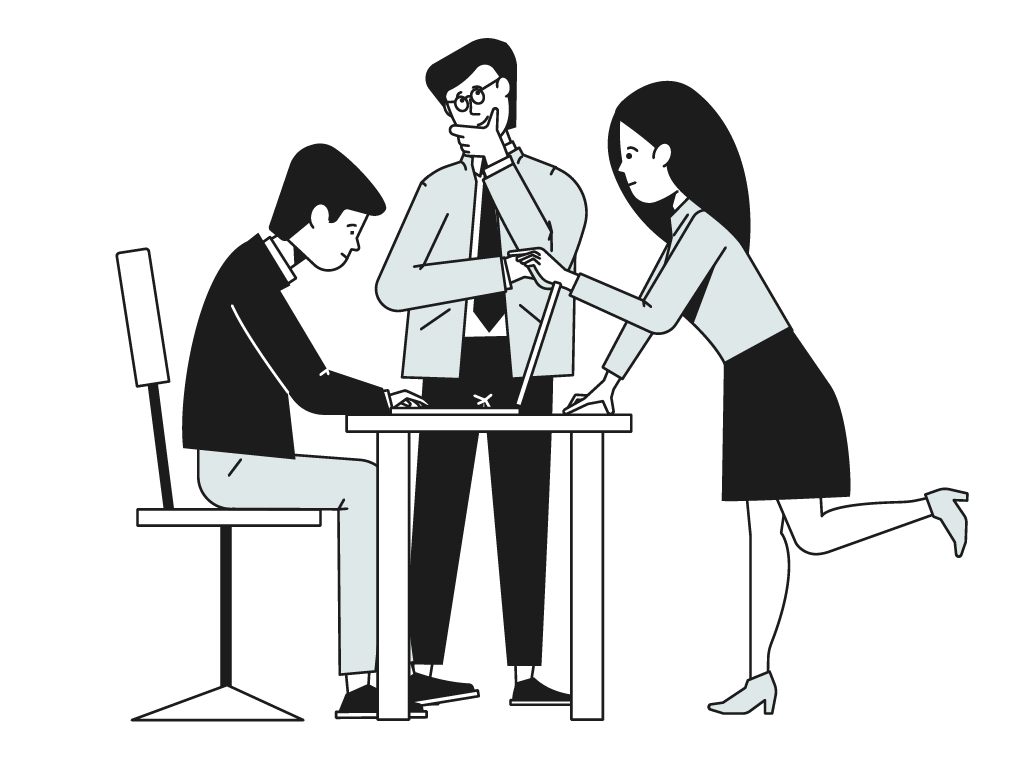
Within the group, there are several roles:
- Among the participants, the "customer of the day", who explains the situation he is facing
- Among the participants are the "consultants" who provide answers, give advice and suggest courses of action.
- The coach, who leads the session
The benefits of my co-development / codev coaching
- Renewed professional practice based on real-life situations rather than case studies (training)
- A greater sense of effectiveness, particularly in terms of teamwork, "internal politics" and creative problem-solving
- A consolidated professional identity, thanks to a greater ease with their role and the culture of the company, and a better understanding of the reality of their colleagues
- Participants are more motivated and loyal
- Participants go on to complete their vocational matriculation
- The methodological framework of the codev is guaranteed by a contract and by my commitment to respect the ethical commitments of the International Coaching Federation, in particular regular professional supervision, coupled with intervision between certified peer coaches.
It should be noted that these group coaching sessions can be effectively combined with an individual approach for certain team members, which could include a personal development component, for example.


Let's work together!
Support schemes linked to this theme
?
FAQs on Professional Co-Development
1. What is professional co-development?
Professional co-development is a development approach in which peers learn from each other to improve their practice. It was developed by Claude Champagne and Adrien Payette and is based on a structured process of consultation between participants. Claude Champagne is a Quebec psychosociologist and co-creator of the professional codev concept with Adrien Payette.
2. How does the co-development consultation process work?
The co-development consultation process consists of discussing professional issues currently experienced by participants. This enables unique learning through reflection and advice from peers.
3. What are the basic principles of co-development?
The basic principles of co-development include the idea that professional practice produces unique knowledge, that discussing with peers enables unique learning, and that it is important to let difficulties emerge in order to learn to act better in one's practice.
4. Who can take part in a co-development session?
Co-development sessions are designed for a group of peers at the same seniority level, for example managers, senior executives or company directors, working in different departments or teams within the same company.
5. What are the benefits of a co-development session?
Co-development sessions help to renew professional practices based on real-life situations, increase the feeling of efficiency, consolidate professional identity and encourage motivation and loyalty among participants.
6. How does a co-development session work?
During a co-development session, a participant presents a professional problem as the "client of the day". The other participants act as "consultants", offering solutions and advice under the guidance of a coach.
7. What are the differences between co-development and traditional training?
Unlike traditional training, co-development focuses on real-life situations experienced by the participants, encouraging practical, concrete learning.
8. How is codev different from team coaching?
What these two approaches have in common is collective intelligence, which is often used to solve problems or develop working methods, with observable and measurable objectives.
Team coaching aims to work on the relational processes within a team, to help the group work better together. The aim is to develop a shared vision (for example, how to translate the company's values into concrete actions) or to diagnose the way things work (for example, clarifying the roles of each team member), and then to put in place an action plan for the team. All team members are present, and team coaching takes account of hierarchical links.
In contrast, the codev brings together peers with no hierarchical link. And it does not focus on the relational processes within the group, but on solving a concrete, real and current problem brought by a member of the group, thanks to the experience shared by the other members of the group.
9. How does co-development promote organisational development?
Co-development reinforces an organisational culture based on trust, cooperation and collective intelligence, fostering organisational development and creative problem-solving.
10. What is the feedback from co-development participants?
Co-development participants report an increased sense of efficiency, a better understanding of their colleagues' realities, and greater motivation and loyalty within the company.
11. How can co-development be integrated into a professional action plan?
Co-development can be integrated into a professional action plan as a tool for personal and professional development, encouraging continuous learning and improving interpersonal and managerial skills.